How To Choose The Best Sewage Treatment Plant Manufacturer In India ?
This budding nation including both residential as well as commercial manufacturing industry is situated in this Indian state. With a population of more than 1.50 Billion & a continuously mounting set-up of small to medium-sized to large industries in the papers, sugar, steel refining, textile-clothing, lentils milling, & various distillery sectors, India is a dwelling to various industrial estates.
However, everyday sewage or
industrial waste-water creation is increasing as these enterprises &
residential neighborhoods increase, making safe waste management & its
wastewater-processing more difficult.
The incapacity of the sewage system
that one maintains up with the rapid expansion of new residential developments
with the expanding city limits simultaneously leads to ground-water pollution. This
demonstrates the critical need for Sewage Treatment Plant Manufacturer such as Netsol Water to reduce as well as minimize water contamination
across this state.
The critical demand for all kinds of STP plants
According to current conservative
assessments, the output quantity of industrial sewage from India's operational
industries has already surpassed 70-75k MLD. Since it depends on the
availability of reasonably priced or inexpensive land-possessions
& man-power, this will likely expand by two to three times over the
course of the following five decades when more production plus backup
facilities are operational.
Additionally, given the country's
population growth rate, each family now generates atleast or more than
600–700 LD of sewage, while that amount is predicted to steadily rise.
The Natural Resources Management
& Wastewater Control Authority recommends a few crucial methods to deal
with strong stormwater concentration flowing lines before fully purifying
them in compliance with the authority's most recent discharge restrictions,
such as the ZLDP networks, there is an important technological shortage
alongside an important delay in current treatment capabilities.
After being released, untreated
sewage harm surface as well as groundwater supplies closer to the region,
making them unfit for usage by people because of their high concentrations of
contaminants like B.O.D, total dissolved solids, chlorides, & several
other substances that are above permissible limits.
Therefore, building improved sewage
treatment infrastructure should be a top priority for local government as well
as companies in the next years.
Major Functions that Netsol Water is doing to improve the Water Condition
Using cutting-edge, cutting-edge
technologies like electro coagulation, ultra filtration, and sequential batch
reactors, Netsol Water, an emerging
company, is well-known for creating and manufacturing specialized sewage
treatment plants in compliance with industrial and regional
application-specific requirements.
Netsol Water provides reasonably
priced STP plants with locally accessible infrastructure for expanding
industrial towns or cities that need to minimize land area and power
utilization due to high pollution levels and limited financial resources.
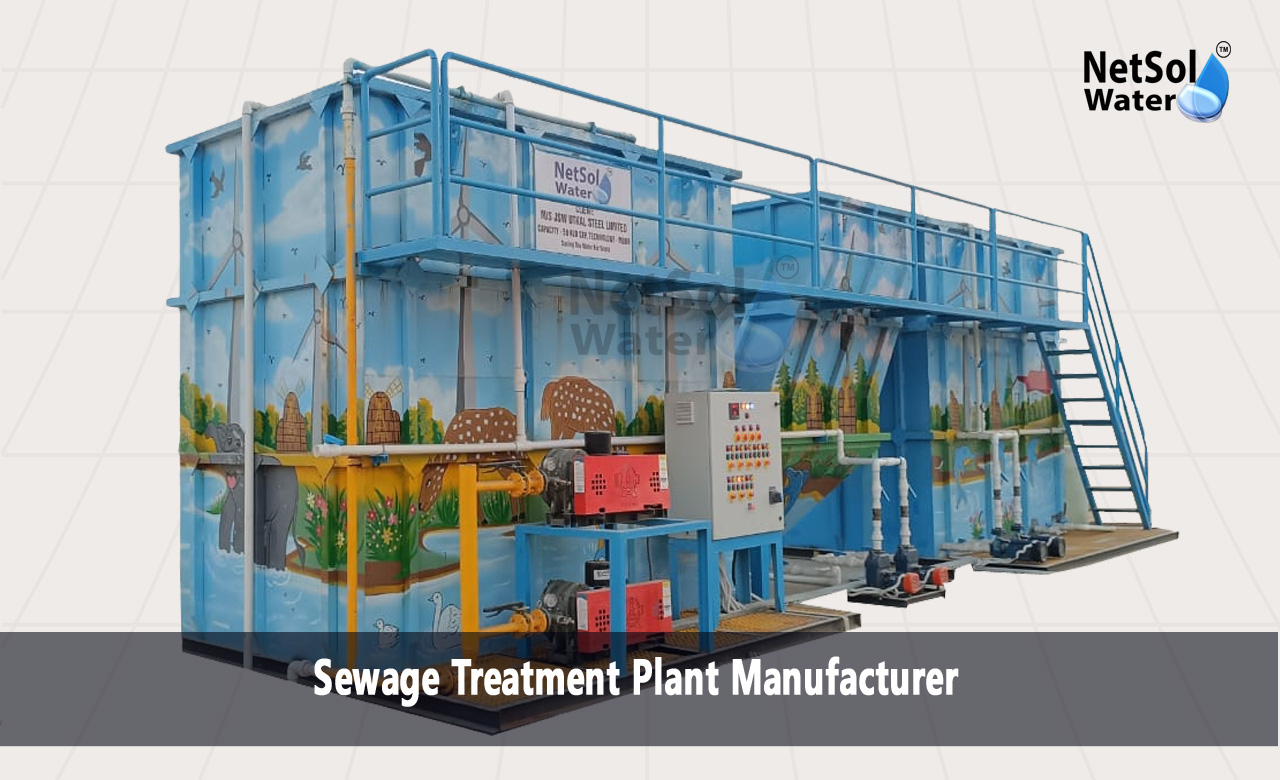
Strategy for Including the Most High-Level Updated Technologies in STP Plants Available
Based on forecasts from the Environmental Pollution & Control Board & Nations’ Development Authority, the following tactics, tailored to the desired setting, can be implemented by Sewage Treatment Plant Manufacturer:
1) Common STP Framework for Municipalities: To service upcoming big commerces & special economy generating zones where Enhanced Aeration-Activated Sludge devices can be placed & installed, Municipal Corporation/Authority can build conveyance pipelines & wastewater collection tanks. Individual member units are required to pay a membership fee to access this feature.
2) Segregating C.O.D. fractions & producing sewage discharges with variable contamination concentrations from larger facilities such as the sugar & distilling industries are two necessary aspects of gradual wastewater treatment methods.
3) Recyclable Water Handling via Reverse Osmosis: Reverse osmosis facilities are used by many commercial enterprises to treat incoming water, resulting in an ongoing source of RO recyclable water with a substantial TDS load.
Instead of throwing away this saline waste stream, Netsol Waters may incorporate specialist ZLDP (Zero Liquid Discharge) modules, including Agitated Thin Film Dryers & Crystallizers, to turn it into recyclable materials, like sodium chloride crystals.
4) When applying this technique for the treatment of sewage in urban neighborhoods or individual housing societies, relatively relatively inexpensive sequential batch-reactor driven STP treatment systems are very straightforward to build along with highly space-efficient. Before being released into any nearby fields of the environment, tanks, or water channels, they have been employed to cleanse domestic wastewater on-site. This decentralized approach makes sense given the uneven sewage network coverage of that region.
5) Tertiary Treatment at the third level of Treated-Sewage: By employing membrane filtration techniques like UF (Ultra Filtration) as well as Nano filtration, secondary treated sewages can be further refined to neutralize small evidence of contaminants before being implemented for less risky tasks on factory grounds, such as sterilizing refrigeration systems, lawn maintenance, etc.
6) Partnerships/Agreements for Servicing during Operation: Every year, as a STP plant manufacturer, Netsol Water renders thorough Operational support for these plants.
Conclusion
Establishing an independently
operated sewage treatment plant manufacturer which can adapt to the particular
requirements of neighborhood areas where people live in as well as
industry is necessary. The state should resort to cutting-edge technical modern techniques
to do this, which are provided by wastewater management partners like Netsol Water.
The newest authority-based
requirement dead-lines state that it can treat all waste-water streams
generated in this quickly growing town, enabling recovering & then reutilizing.


Comments
Post a Comment